When he was at Novell in the 80s, Craig Burton changed the concept of networking by making Netware hardware-independent. Later, at The Burton Group, he drove a new understanding of networks — as services (file, print, directory, security, management) rather than "pipes & protocols."
Lately he has been turning his attentions to open source. As always, his thinking is highly unique, independent and not part of anybody's orthodoxy. We caught up with him for a brief interview just before and after he moderated a panel in April at Linux Journal's "Linux For Suits" event at Internet World.
— Doc Searls
Linux Journal: First, personalities. What do you think of Steve Ballmer? You tangled with him a lot in the past.
Craig Burton: He's a very straight shooter. You may not agree with him, but at least you know where you stand with the guy.
Linux Journal: He had a funny line about Linux a couple weeks ago. He said "it's the first time I've seen Unix on the right platform." But then he followed that up with some challenging statements, saying that open source is good for some things and not for other things —
Craig Burton: — He's wrong to take that approach. He could say "Look. We've always done open source. This is nothing new."
Linux Journal: What have they done? Run that down for me.
Craig Burton: What is MAPI? What is NetBios? What is ODSI? There are all these things that they've done that they basically given away as open source. See, open source is a licensing agreement. It comes down to what we agree on when one of us uses the other's code.
Linux Journal: And it's not just about source.
Craig Burton: There are questions of source, binaries, licensing and derivative works. Here's a matrix that will make sense of the issue. It de-collapses a number of distinctions that are confusingly collapsed right now.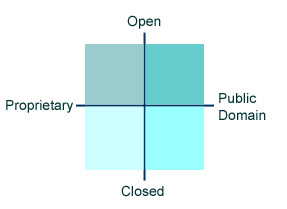
This is the matrix that we need to understand, given any technology. Microsoft has reluctantly participated in the open source corner of that matrix, and over the time has moved a lot of technology into the open/public domain quadrant. And a lot of stuff they haven't. But the only significant difference between the open source commuity's products and Microsoft's is the amount of core technology that is made available in the open source half of that matrix. Red Hat has a bunch of stuff that they don't open source. TurboLinux too. So does everybody else. So what?
Linux Journal: So you don't believe that because most of Microsoft's familiar software is closed source, that it sucks?
Craig Burton: First, some of it sucks and some of it doesn't. In either case, it doesn't matter because customers are buying it and using it. I don't see open source developers competiting with it, either.
Linux Journal: All three desktop office suites for Linux — from Applix, Sun and Corel — are closed source.
Craig Burton: Exactly. And they're all clones of Microsoft office to a significant degree. But let's stay with the core issue here. That issue isn't just about open and closed source code. Looking for fights between those two invites a lot of collapsed distinctions. Software varies greatly in accessibility, and open source isn't the only variable. In many cases you can get at the APIs but not the source code. That makes the software somewhat more open than if the APIs and the source are closed.
Linux Journal: So you've got a problem with calling something closed, or inaccessible, when it's not, and vice versa.
Craig Burton: We all have a problem with that. We're confusing a pile of issues. For instance, the fact remains that most Linux distributions are chock full of stuff that's both closed and proprietary. We just excuse it because it's bundled with something that called "open."
Linux Journal: Give me some examples of closed source that essentially passes for open in the Linux world.
Craig Burton: Security components that use PKI — Public Key Infrastructure. We're talking about copyrighted, patented stuff. Proprietary as can be.
Linux Journal: You mean RSA.
Craig Burton: Right. The distributions can't open source that stuff. And it's all over the place.
Linux Journal: Let's go to the big picture here. I watched you change the whole networking conversation back in the 80s, from one about wires and protocols to one about services. Are we at a similar cusp at this point in time?
Craig Burton: I think we are. For some reason there's this idea that the Net is a finished thing. In fact it's only beginning. One of its virtues is that it's still wide open. And it would help if more of us understood that openness — the ability of infrastructural software to interoperate without interference by anybody's agenda — is what enables growth. Over time, as Microsoft is discovering, the challenge is moving infrastructural code to the upper right corner of this matrix. There is a big movement right now to copyright and patent everything you can name, but in the long run that's wasted effort. It's more rocks in the stream of progress. History will flow around these obstacles. The real questions companies need to ask is not "how do we patent and copyright and protect our stuff," but "How do we make money and do business while we gradually moving toward that upper right quadrant?" To do that, you need to see the Net as something that still desperately needs a lot of infrastructure.
Linux Journal: Such as?
Craig Burton: Directory and security services, which go hand in hand, are still very primitive. (Craig, fill in whatever that directory thing is that Linux has.) Within Linux itself, it's old UNIX legacy stuff that hasn't changed in many years. Before we can have real privacy, and real secure communications, and real useful directory services — which we'll need to keep track of a world of abundant, changing and distributed objects — we're going to have to evolve past that legacy? How?
Linux Journal: Novell wants us to use NDS. Microsoft wants us to use Active Directory.
Craig Burton: And neither will be adopted by the Linux community, which is necessary for this whole thing to move forward. They're both proprietary and in the way. Rocks in the stream.
Craig Burton: How do you conceive the Net? What's its conceptual architecture?
Craig Burton: I see the Net as a world we might see as a bubble. A sphere. It's growing larger and larger, and yet inside every point in that sphere is visible to every other one. That's the architecture of a sphere. Nothing stands between any two points. That's its virtue: it's empty in the middle. The distance between any two points is functionally zero; and not just because they can see each other. Rather because nothing interferes with the operation between any two points. There's this great word I found in the Oxford English Dictionary — terraform. It's the creation of a world. That's what we have here: a new world. Now the question is: what are you going to do to cause planetary existence? How can we terraform this new world in a way that works for the world and not just ourselves. Remember, this thing is in outer space. It's not connected to anything else. If you want to live here, you have to bring your own sustaining structures, foods and the rest of it.
Linux Journal: Is this something like what Larry Lessig calls "end to end" architecture?
Craig Burton: I haven't read much of Lessig's work yet, but I believe we're consistent here. But since we're talking about authors, I also like Carl Shapiro and Hal Varian's Information Rules, which makes pragmatic distinmctions between the economy of building things and the economy of building information. The old econoumy was driven by economiiss of scale, including time, resources and materials. The open source community claims this is outdated, and they're right. But now what? These guys say that the economics of information invite respect for network effects, which can be increased by leveraging the value of intellectual property, rather than by protecting that property. A key to understanding the economies of networks is seeing that networks are comprised of relationships. That favors companies that build and maintain relationshipe through one of your favorite subjects: conversations.
Linux Journal: And we have a lot left to talk about.
Craig Burton: A huge amount.